The Right Colour: Our walls are lime green, and any picture should match this tastefully.
Easy on the Eye: We don’t exactly have that Brian Sewell coming round for dinner too often, so no art in the house should be too challenging for our guests: poetic or classical scenes, countryside and animals, etc would probably be OK.
No Pornography: I did bring over some smaller pictures, including Edvard Munch’s lovely Yellow Madonna - that’s the mother of Jesus, not the Madonna - but Mrs Dilo’s convinced it’s Pornography! She’s even insisted I keep it my study, with a small curtain that can be drawn across it. I’ll have to be careful.
This narrows it down, and to narrow it down even further I’ve decided (for this first selection): No Rubbish. Here are some I’ve found that may fulfil the criteria:
 #1 The Farmer's Daughter (by John Everett Millais): Mrs Dilo and I liked the recent Millais exhibition at London’s Tate Gallery - very Christmassy. This is like that sweet little Connemara Girl, but this one’s made a bit more of an effort. She’s a ginger, so is never going to be appreciated as anything except “Art”; but, oh, what if she starts feeling tired carrying all that milk about and has a lie down in the grass and... oh, I mustn’t think about that – maybe the wife will see what I’m thinking.
 #2 The Washerwomen (by Camille Pissarro): Mr Pissaro’s pictures have plenty of green in them, like he got a job lot of it and didn’t want to waste it - I’m the same. Like me he also loves to watch women at work - but, hang on, what if they splashed each other and their blouses became really quite wet and....? Ah.
 #3 The Lady of Shalott (By John Waterhouse): You really can’t beat the Pre-Raphaelites for sheer good taste - and gingerness. And there’s some nice greens here and.... but, oh heck, imagine if she thought nobody was watching and decided to take off her clothes and have a skinny dip??
 #4 Deux Poires (by Édouard Manet): Paintings of actual limes – which would be perfect for our wall, obviously – were rarely done by your old masters, but other fruit can be a similar colour. Here.... oh, no, that’s just one pair, Édouard – we know what you’re trying to suggest.... typical bloody Frenchie!
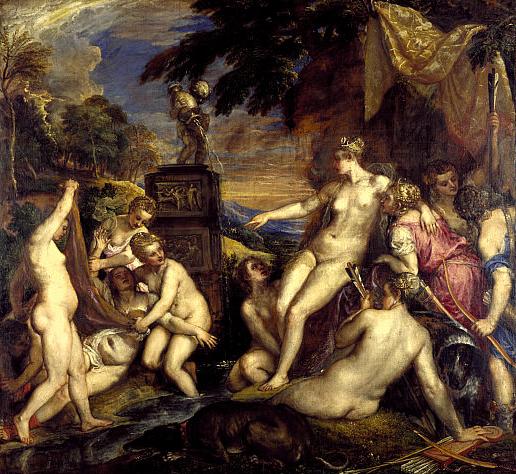 #5 Diana and Callisto (by Titian): Blimey! This is more difficult that I thought it would be. A nice classical scene, outdoors, and I think there's even a farmyard animal in there somewhere, but..... And here’s loads more where this came from!! I had no better luck with dryads or nymphs either.... I’m going to have to give this up.
 #6 The Alan Carr “Tennis Girl” Poster: Ah, now, maybe this is the one: tennis is classy, there’s some green in the background, and it’s a classic scene - the original Athena poster showing a girl on a tennis court scratching her arse (remember?) was indeed a classic, selling 2 million copies – but luckily here there’s not a woman in sight. I can’t see anybody objecting to this.
Ok, now the “prize”: choose the one you think is best for us and you could win Gadjo’s Turner Prize! Yes, Lana/Tina/Anthea/Alan Turner (subject to availability) will visit your home, dance for you, and let you paint her/his sensual, writhing, naked body with a set of Rowney Artist's Watercolour paints in the art movement style of your choosing - Fauvism, Dadaism, Vorticism... it’s entirely up to you. In the next episode – when the painting you’ve chosen is up on the wall and accepted as part of the furniture - I’ll offer you a selection to chose from that’s a little more modern and daring. To end, and especially for zmkc, here’s the immortal Peter and Dud on the subject: